
 AI Chat
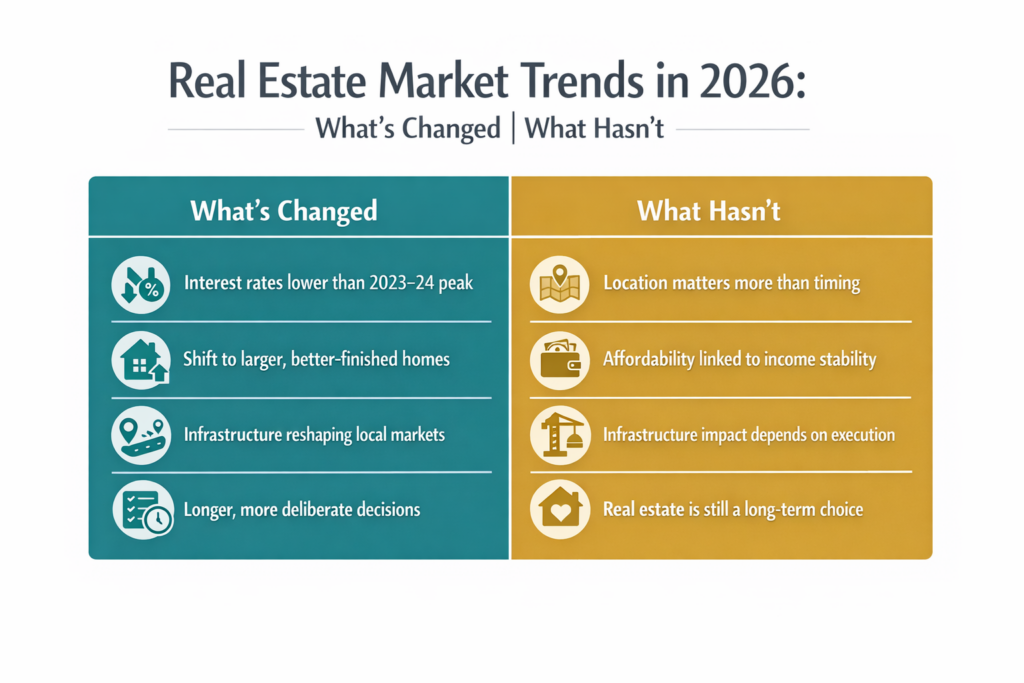
The Indian real estate market trends in 2026 look very different from earlier cycles. There is less urgency and far fewer rushed decisions. Homebuyers are spending more time evaluating location, construction quality, and long-term comfort, rather than worrying only about short-term price movements.
This blog outlines the key real estate market trends shaping India in 2026, so you can decide with context rather than noise.
A Supportive Economic Backdrop Without Euphoria
India enters 2026 with a relatively stable economic environment compared to many other major economies. Growth expectations remain steady, private consumption supports demand, and inflationary pressures have eased from earlier highs.
For homebuyers, this stability mainly reduces uncertainty. While it does not guarantee returns, it makes it easier to plan long-term purchases like a home. Compared to earlier cycles shaped by sudden policy shifts or demand shocks, the current phase is slower and more measured, giving buyers time to compare options and decide thoughtfully.
What this means for your home-buying journey:
- More predictable EMIs: Reduced volatility in interest rates makes loan planning more stable.
- Less urgency: Buyers can evaluate locations and projects without pressure to rush.
- Some budget flexibility: Moderating price pressures may make monthly commitments easier to manage for some households.
For those tracking real estate market trends, this backdrop signals lower macro risk rather than automatic opportunity. The value lies in clearer decision-making, not guaranteed outcomes.
Interest Rates and Housing Affordability in 2026
One of the most closely watched real estate market trends in 2026 is housing affordability in India, and how interest rates affect monthly EMIs.
After a prolonged period of higher borrowing costs, the Reserve Bank of India reduced policy rates through 2025. As a result, home loan EMIs are lower than their earlier peak levels, easing some of the pressure on household budgets. By early 2026, monetary policy has moved into a wait-and-watch phase, allowing the impact of previous rate reductions to flow through the system.
For homebuyers, lower borrowing costs can improve affordability at the margin, especially in mid-range and premium housing segments. However, interest rates alone are not a reason to rush into a purchase.
In the current cycle, the more important question is not, “Are interest rates low?” It is, “Does this home remain affordable if rates stay where they are today?”
Practical considerations for buyers:
- Plan for stability, not further cuts: Treat current EMIs as a baseline rather than assuming future reductions.
- Build in a margin of safety: Before finalising a loan, it helps to check whether your monthly budget remains comfortable if rates were to rise modestly in the future.
- Focus on long-term affordability: A home that fits comfortably into your finances today is more likely to remain manageable over the life of the loan.
Seen in this light, interest rates in 2026 support planning and clarity rather than urgency, aligning with a more deliberate phase in real estate market trends.
Why Premium Homes Lead the 2026 Real Estate Trends
One of the clearest real estate market trends in recent years is the gradual premiumisation of housing demand.
Across major cities, developers are increasingly focused on higher-value homes, while supply in lower price segments has tightened. This shift is shaped by rising land prices, higher construction costs, and stricter compliance norms, which have made smaller-ticket projects harder to execute.
In 2026, “premium” is less about visible luxury and more about how a home supports everyday living. Buyers are prioritising usable space, work flexibility, lower crowding, and execution reliability over decorative upgrades.
What defines a “Premium” home in 2026?
- Dedicated work-ready spaces that support hybrid routines
- Lower-density developments with fewer homes per acre
- Wellness and sustainability features that are increasingly expected
- Reliable execution, with delivery track record carrying more weight than branding
How standards have evolved
| Feature | 2022 Lifestyle | 2026 Premium Standard |
|---|---|---|
| Work | Working from the dining table | Dedicated home office with soundproofing |
| Parking | Standard basement parking | EV-ready slots with smart monitoring |
| Density | 500+ units in a small cluster | Low-unit counts with private lift lobbies |
| Amenities | Basic gym & pool | Wellness spas & boutique fitness studios |
Infrastructure: The “20-Minute City” Narrative
In 2026, buyers have moved beyond simply choosing homes that are “near a highway” or “close to a metro line.” Infrastructure continues to influence real estate market trends, but its impact is no longer uniform across locations.
What matters now is whether infrastructure actually makes daily life easier. Proximity on a map does not always translate into real connectivity on the ground.
How to identify infrastructure-led locations that tend to perform better:
- Walkable access matters
- Last-mile quality is critical
- Peripheral locations with real connectivity
For buyers, the takeaway is to focus on micro-markets rather than city-wide announcements. Infrastructure creates opportunity only where it translates into practical, everyday connectivity.
Pune as a Lens on India’s Real Estate Market Trends
Pune offers a useful lens for understanding how real estate market trends play out in a city driven largely by end-user demand.
Key takeaways from Pune’s market:
- Demand follows employment
- The upgrade buyer effect
- East versus West dynamics
What buyers can learn from this:
- Look for active communities
- Prioritise resilience over spikes
Technology, Transparency, and Changing Buyer Behaviour
Another important real estate market trend is the gradual improvement in transparency.
Technology is making decisions easier, but it is not removing complexity.
Emerging Real Estate Market Trends to Watch
- Senior living
- Flexible workspaces
- Data centres and digital infrastructure
What Real Estate Market Trends in 2026 Mean for Buyers
India’s real estate market trends in 2026 point to a clear shift in behaviour.
The focus has moved away from speculation and toward planning.
That shift is the most important real estate market trend of 2026.